
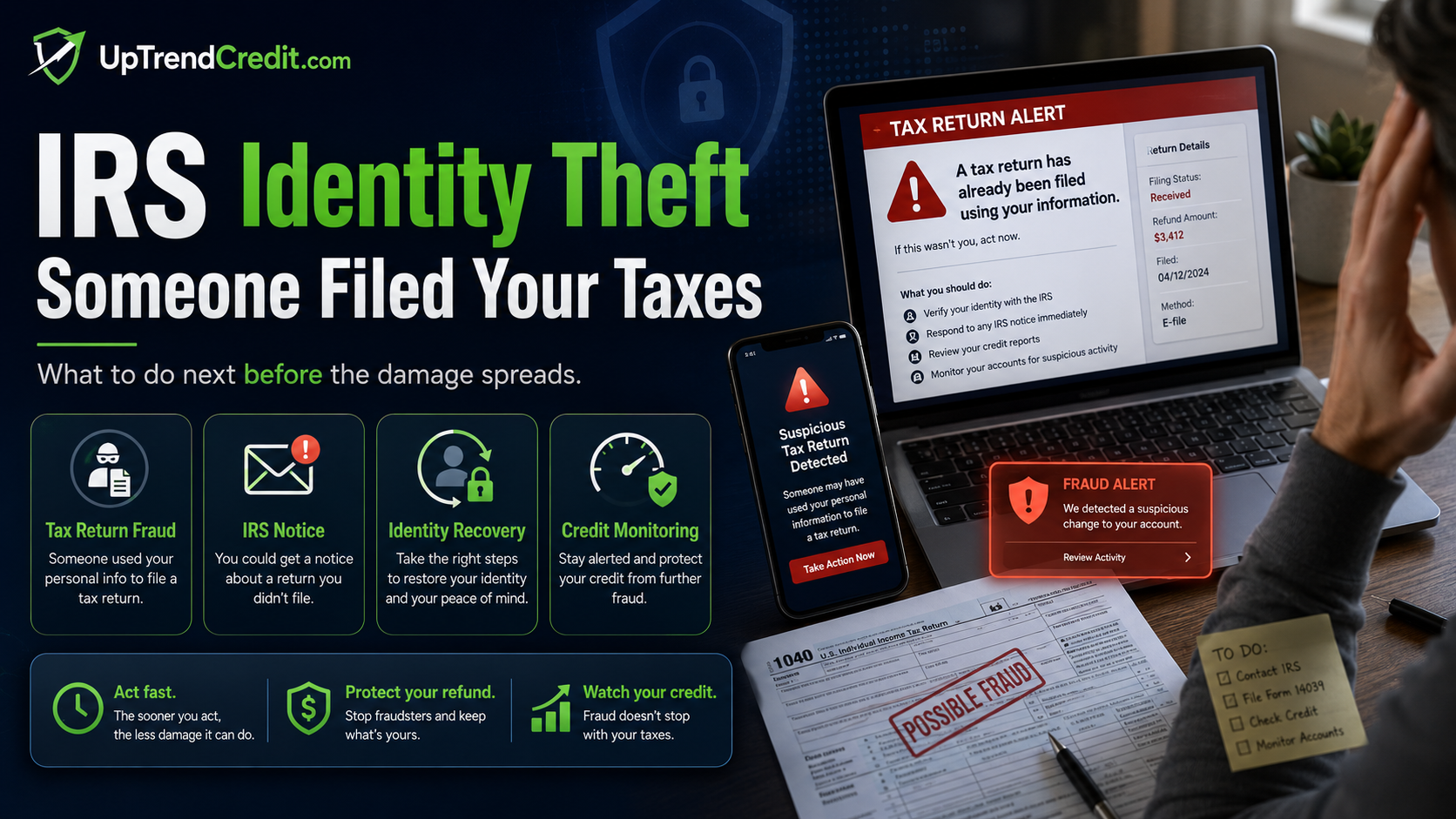
Someone Filed Your Taxes. The IRS Has 500,000 Cases Backed Up. Here's How to Fight Back.
Your refund can be frozen for nearly two years. These 9 steps — done in order — are the fastest path through it.
- Your refund is not gone. It's delayed — up to 20 months. File your real return and stay in the process.
- You still need to file by the tax deadline. The penalty clock doesn't stop because of fraud. Failure to file = 5% per month.
- The thief doesn't stop at tax fraud. The same SSN can be used for unemployment fraud, credit cards, and health insurance claims.
- Tax fraud and credit fraud use the same stolen data. Freeze your credit today — all three bureaus.
- An IP PIN stops this from ever happening again. Free. 15 minutes. Get it before you file again.
- You have a legal right to see the fake return they filed. Form 4506-F — most victims never know this exists.
It Happened. And It Wasn't Your Fault.
You tried to e-file. The IRS kicked it back.
"A return has already been filed using this Social Security number."
Or a letter arrived. IRS letterhead. Your name. About a return you never filed.
Either way — you didn't cause this. Tax thieves buy stolen SSNs on the dark web, often from data breaches that happened years ago. A breach from 2022 can fuel fraud in 2026. You can do everything right and still end up here.
What matters now: 500,000 people are in this line ahead of you. The IRS is averaging 20 months to resolve these cases. The agency won't move faster because you're angry. It moves faster when you do the right steps in the right order.
That's what this guide is for.
Take the 60-second identity theft risk quiz — free, no sign-up required.
Take the Free Quiz →How You Found Out Changes Your First Move
Don't guess. The right first step depends on exactly how you discovered this.
| How You Found Out | What It Means | Your First Move |
|---|---|---|
| E-file rejected — duplicate SSN | Someone filed before you. May have already collected a fraudulent refund. | File your real return on paper with Form 14039 attached |
| IRS letter — 5071C, 4883C, or 5747C | IRS caught it before paying out. Good news — act on the letter immediately. | Follow the letter's exact instructions — do not call the general IRS line |
| W-2 from unknown employer | Someone is working under your SSN. This also corrupts your SSA earnings record. | File Form 14039 + contact SSA at 800-269-0271 |
| 1099-G for unemployment you never collected | Unemployment fraud using your SSN — common after tax identity theft. | Report to your state unemployment agency + file a corrected federal return |
| IRS says you owe unreported income | Employment fraud — their wages filed under your number. | Follow IRS letter, file corrected return, contact SSA |
The IRS caught a suspicious return before the refund went out. Respond immediately. You may still prevent the thief from collecting your money.
The 9 Steps — In the Exact Right Order
Sequence matters. The wrong step first doesn't just waste time — it can delay your case assignment by weeks. Work this list top to bottom.
The IRS Letter in Your Hand — What It's Telling You to Do
Each letter has its own process. Use the wrong one and you delay your own case.
| Letter | What It Means | How to Respond |
|---|---|---|
| Letter 5071C | Suspicious return flagged. Online verification available. | ONLINE Go to idverify.irs.gov using the link on the letter |
| Letter 4883C | Suspicious return flagged. Phone verification required. | PHONE Call only the number printed on the letter |
| Letter 5747C | In-person identity verification required. | IN PERSON Schedule a Taxpayer Assistance Center appointment |
The IRS reported over 600 social media impersonators in FY 2025. AI-enabled robocalls with spoofed caller ID now specifically target identity theft victims. The real IRS never demands immediate payment, threatens arrest, or asks for gift cards. Use only the contact information printed on the letter — not a number from a web search or an unsolicited call.
The One Free Thing That Makes You Virtually Immune to Tax Fraud
Most guides mention this in one line. It deserves its own section.
An IP PIN is a free six-digit number the IRS issues each January. It goes on every tax return filed under your SSN. Without it? The IRS rejects the filing. Any filing. Including fraudulent ones.
No IP PIN = the thief can try again next year with the same stolen data. IP PIN = they can't file even if they have everything.
- Go to IRS.gov/IPPIN and sign in to your IRS online account (or create one using ID.me)
- Verify your identity — you'll need your SSN, a photo ID, and a phone number for the verification code
- Your IP PIN appears immediately. Write it down somewhere secure.
- Your PIN changes every January — log back in before filing each year to retrieve the new one
- Get one for each dependent child — their SSNs are a top target and theft can go undetected for 15+ years
- Can't verify online? File Form 15227 (AGI under $84,000 / $168,000 joint) or visit a Taxpayer Assistance Center in person
- Filing in Spanish? Form 14039 and Publication 5027 (Identity Theft Information for Taxpayers) are both available in Spanish at IRS.gov — search "Publicacion 5027"
What Nobody Tells You About the Next 20 Months
Here's the part that separates people who get through this from people who give up.
The IRS handles two distinct categories of cases. Knowing which one you have determines your realistic timeline.
Category 1 (~2.1 million returns flagged in 2025): The IRS detected a suspicious return and sent you Letter 5071C, 4883C, or 5747C before paying out. These resolve in weeks to a few months once you verify your identity. Respond to the letter immediately.
Category 2 (~500,000 confirmed cases, currently backlogged at 20 months): A thief filed first, may have already collected a fraudulent refund, and your e-file was rejected as a duplicate. This is the slower, harder category. These are the cases the National Taxpayer Advocate has called unacceptably delayed.
Facing financial hardship — at risk of losing housing, utilities, or food security? The Taxpayer Advocate Service is free and operates independently from the IRS. They can escalate your case. Call 877-777-4778. The IRS workforce was cut by 26% in 2025 — from about 102,000 to fewer than 76,000 employees — making the backlog worse. TAS is your best path to faster resolution.
How This Hits Your Credit, Your Unemployment Record, and Your Health Claims
The fraudulent tax return itself won't appear on your credit report. But the thief doesn't stop there.
The same SSN, date of birth, and address that let someone file your taxes also lets them open credit cards and take out loans. They can apply for unemployment benefits and set up health insurance — sometimes the same week. Most victims discover the tax fraud first. The other fraud surfaces later.
Watch for these three downstream consequences — they're common and they're damage that outlasts your IRS case:
Credit accounts opened in your name. Hard inquiries and new tradelines appear on your Experian and TransUnion reports. Missed payments on those fraudulent accounts create late marks that can drop your score 60–110 points and stay for seven years. Pull your reports now at AnnualCreditReport.com. Dispute every account you didn't open — in writing, with your FTC report number attached.
Unemployment fraud. If you receive a 1099-G for unemployment benefits you never collected, your SSN was used to file a fraudulent unemployment claim. Report it to your state unemployment agency immediately using their fraud reporting page. Then file a corrected federal return that excludes the fraudulent income — the IRS has specific guidance at IRS.gov for correcting 1099-G errors.
Health insurance or medical fraud. The same stolen data can be used to obtain health coverage or file medical claims in your name. Check your Explanation of Benefits statements for procedures you don't recognize. Contact your insurer and the provider to file a fraud report.
A credit freeze stops new fraud from happening. It doesn't undo fraud that already happened. Monitoring catches it in real time — before a fraudulent account goes to collections or a fraudulent medical claim shows up on a background check.
While You Wait 20 Months — Let Someone Else Do the Recovery Work
The thief still has your SSN. They may try again — next filing season, next month, with an unemployment claim or a credit card application. Aura assigns you a dedicated restoration specialist who handles the paperwork, disputes, and creditor calls on your behalf. Not just alerts. Actual help.
Dark web + SSN monitoring · $1M identity theft insurance · Credit monitoring · Lost wallet protection · Family plans available
Get Aura's Full Identity Protection →Sponsored · Plans from $12/month · 14-day free trial · See site for full terms.
How to Know You're a Victim Before the IRS Tells You
Most victims find out weeks after the fraudulent refund was paid. These signals catch it earlier.
The fastest way to check proactively: log into IRS.gov/GetTranscript and request your Tax Return Transcript. If a return was filed under your SSN, it appears there — before the IRS contacts you. Check every January before filing season opens.
| Warning Sign | What It Likely Means | What to Do |
|---|---|---|
| E-file rejected — duplicate SSN | Someone filed before you. Clearest signal there is. | Start the 9-step plan immediately |
| IRS letter about a return you didn't file | IRS caught it — respond that same day. | Follow the letter's exact instructions |
| W-2 from unknown employer | Employment fraud. Someone is working under your SSN. | Form 14039 + contact SSA + contact employer |
| 1099-G for unemployment you never received | Unemployment fraud using your SSN. | Report to state agency + file corrected return |
| IRS says you have unreported income | Their wages reported under your number. | Follow IRS letter + file corrected return + SSA |
| Refund delayed with no explanation | Return may be flagged for review. | Check IRS.gov/WhereIsMyRefund |
| Unfamiliar accounts on your credit report | Credit fraud often follows tax fraud immediately. | Dispute the accounts + credit freeze |
The thief files before you do. Every time. The window is January through April. File as early in January as possible — the moment your W-2 arrives. If you file first, any fraudulent filing that comes after is automatically rejected as the duplicate.
Not a Victim Yet? One Move Makes You Almost Untouchable.
The thief files before you. The only move that stops them completely — regardless of what other data they have — is an IP PIN.
Get yours at IRS.gov/IPPIN before filing season opens. Once you have it, a fraudster with your complete personal information still can't file a return in your name. Free. 15 minutes. No downside.
Four more things that cut your risk dramatically:
- File in January. The moment your W-2 arrives. Don't give the thief February and March to beat you.
- Get IP PINs for your kids now. Children's SSNs are prime targets — fraud goes undetected for 15+ years until they file their first return as adults.
- Turn on two-factor authentication on your tax software. TurboTax, H&R Block, TaxAct — all support it. One compromised password shouldn't hand over your entire tax account.
- Check your IRS transcript every January at IRS.gov/GetTranscript. If someone beat you to it, you find out before you try to file — giving you weeks to respond.
Aura monitors your SSN, dark web, and credit 24/7. If anything changes, a restoration specialist responds — not just an alert that tells you to handle it yourself. 14-day free trial.
Get Aura's Proactive Protection →Sponsored · Plans from $12/month · See site for terms.
Frequently Asked Questions
Move fast — in this order. Respond to any IRS letter using only the contact on the letter. File Form 14039 at IRS.gov. Mail your real return on paper with Form 14039 attached. Report to IdentityTheft.gov and file a police report. Freeze your credit at all three bureaus. Call 800-908-4490. Get a free IP PIN at IRS.gov/IPPIN. See the full 9-step plan above.
WARN Never call the general IRS line for identity theft help. Call the specialized hotline: 800-908-4490.
Your refund is not gone. It's delayed. Even if the thief already collected a fraudulent refund, the IRS issues your legitimate refund separately after the investigation closes. File your real return. Stay in the process. The current average wait is up to 20 months. If financial hardship makes that impossible, call the Taxpayer Advocate Service at 877-777-4778 — they're free and can push for expedited handling.
As of mid-2026, the average is 20 months for confirmed Category 2 cases — where a thief filed first and collected your refund. Category 1 cases, where the IRS flagged the return before paying out and sent you a letter, resolve much faster. More than 500,000 confirmed cases are currently backlogged. The IRS workforce was cut by 26% in 2025. If you're experiencing financial hardship, contact TAS at 877-777-4778.
TIP Keep a log of every IRS letter, agent name, call date, and case number. You will need this documentation throughout the process.
Check your IRS Tax Return Transcript at IRS.gov/GetTranscript. A fraudulent return appears there before the IRS contacts you. Other warning signs: your e-file is rejected as a duplicate. You receive an IRS letter about a return you never filed. You get a W-2 from an employer you never worked for. Or a 1099-G arrives for unemployment benefits you never collected.
TIP Check your transcript every January before you file. Finding fraud before you try to file gives you weeks of lead time.
Form 14039 is the IRS Identity Theft Affidavit — your official declaration that your SSN was used fraudulently. File it when your e-file was rejected as a duplicate or when you suspect fraud without an IRS letter. Do not file it if you already received Letter 5071C, 4883C, or 5747C — those handle it through their own process. Filing twice delays your case.
TIP You can also request a copy of the fraudulent return using Form 4506-F. It shows what information the thief used — and can reveal what else they may be doing with your data.
Yes — and most victims don't know this. You have a legal right to it. File Form 4506-F (Identity Theft Victim's Request for Copy of Fraudulent Tax Return) after your case is assigned. The return shows exactly what information the thief used and what they falsely claimed. Download Form 4506-F at IRS.gov.
Yes. File and pay by the tax deadline regardless of the open investigation. The penalty clock does not stop for fraud victims. Failure to file adds 5% per month — on top of the identity theft case you're already managing. Can't pay in full? Call 800-829-1040 for a payment plan.
WARN Waiting for the fraud case to close before filing your real return is one of the most common — and costly — mistakes victims make.
An IP PIN is a free six-digit number the IRS issues annually. It must appear on every tax return filed under your SSN — without it, the return is automatically rejected. Get yours free at IRS.gov/IPPIN in about 15 minutes. Your PIN changes every January — log back in before filing to retrieve the new one. You don't have to be a victim to get one. Getting it proactively is one of the best free moves you can make.
TIP Get IP PINs for your dependent children too. Fraud on a child's SSN can go undetected for over a decade.
Yes — today. The thief has your SSN, date of birth, and address. A credit freeze at Experian, TransUnion, and Equifax is free, takes about 10 minutes total, and is fully reversible. It doesn't affect your current accounts or score. Pull your reports at AnnualCreditReport.com first to check for accounts you didn't open — a freeze stops new fraud, not fraud that already happened.
In most cases, no. The Taxpayer Advocate Service (877-777-4778) is free and operates independently from the IRS. A licensed CPA or enrolled agent can represent you before the IRS for much less than an attorney. Consider a tax attorney only if you owe significant taxes on phantom income, received a levy or lien notice, or the fraud involves a business EIN.
TIP Try TAS before spending money on professional representation. They have real power to escalate cases and are completely free.
These are identity verification letters from the IRS Taxpayer Protection Program. Letter 5071C offers online verification at idverify.irs.gov. Letter 4883C requires a phone call to the number on the letter only. Letter 5747C requires an in-person visit to a Taxpayer Assistance Center. Use only the contact information on the letter — scammers, including AI-powered robocalls, impersonate these letters specifically to target fraud victims.
Get an IP PIN for your dependent immediately at IRS.gov/IPPIN. With a valid IP PIN, you can e-file claiming your dependent even if someone already filed using their SSN — the IRS accepts this as of 2024 tax returns. Also file Form 14039 on behalf of your dependent. Children's SSNs are prime targets because no one monitors them — fraud often goes undetected for 15+ years, until the child files their first return as an adult.
TIP Get IP PINs for all dependent children now — even if you haven't been a victim. It's free and protects their credit history before they even know it exists.
Report it to your state's unemployment insurance agency immediately — most have an online fraud reporting portal. You may receive a 1099-G tax form for benefits you never collected. File a corrected federal return excluding that income as soon as you discover it. Do not ignore the 1099-G even if you know it's fraudulent — the IRS will treat unreported income as owed taxes until you correct it. See IRS.gov for guidance on correcting fraudulent 1099-G forms.
WARN A fraudulent 1099-G makes the IRS think you owe taxes on income you never received. File a corrected return immediately — don't wait for the unemployment fraud investigation to close first.
The Bottom Line
Someone violated your SSN. Your refund is delayed. The IRS has 500,000 cases ahead of yours and takes 20 months on average.
None of that is your fault. And none of it is permanent.
The people who get through this fastest work the system. They file the paper return, report to the FTC, freeze the credit, get the IP PIN, and stay in the process. The ones who don't? They wait for the IRS to fix it on their timeline.
Your money is coming. The question is whether you do the steps that get it there — and whether you have someone watching your back while you wait.
You Need More Than Alerts. You Need Someone to Fight This With You.
Most monitoring tools send you an alert and leave you to handle it alone. Aura is different — a dedicated restoration specialist works the case on your behalf. Given that you're already navigating the IRS for 20 months, that matters.
Sponsored links · Aura and IdentityIQ are paid services. Aura plans from $12/month with 14-day free trial. IdentityIQ from $6.99/month. Rates and terms vary — see each site for full details.
- IRS Identity Theft Central — official guidance hub (verified July 2026)
- IRS — How Identity Theft Victim Assistance Works
- IRS Form 14039, Identity Theft Affidavit (Rev. 2-2026)
- IRS Form 4506-F, Identity Theft Victim's Request for Copy of Fraudulent Return
- IRS — Get an Identity Protection PIN (IP PIN)
- National Taxpayer Advocate — FY2026 Objectives Report (June 2025)
- CNBC — "Identity theft victims face 'unconscionable' IRS delays" (June 24, 2026)
- PBS NewsHour — Tax scams rise; AI-enabled IRS impersonation increasing (March 2026)
- FTC Consumer Advice — Tax Identity Theft guide (Rosario Mendez, FTC Consumer Protection Bureau)
- IdentityTheft.gov — FTC recovery portal
- Aura — Identity Theft Recovery Guide